
There are four realistic places to record a podcast in Doha, and each one fails in a different way. Knowing which failure you can live with is most of the decision.
- Home is free and sounds like home. Fine for the first five episodes and audio-only shows.
- Your office is acoustically the worst of the four — glass, hard ceilings, and AC that gets louder in the evening.
- Co-working has office acoustics plus people knocking at fifty-eight minutes.
- A studio is QAR 260 an hour here. You are buying a treated room and a booked slot, not equipment.
- Whichever you pick, batch four episodes at a time. It is the single decision most correlated with a show surviving a year.
Why the room matters more than the microphone
Before the four options, the thing that explains all of them.
In an untreated room your voice reaches the microphone twice. Once directly, and again a few milliseconds later after bouncing off the wall behind you, the table, the window, the ceiling. Your ear filters that second arrival out automatically. A microphone does not — it records both, smeared together.
That smear is what makes home recordings sound like home recordings. It is not a volume problem or a quality problem, and it is the one thing you genuinely cannot fix afterwards. Every plugin that claims to remove reverb works by removing some of your voice along with it.
The quick test, wherever you are considering: record thirty seconds of silence in the room and listen back on headphones. If you can hear the room, your audience will hear it in every episode.
Option 1 — At home
Cost: nothing, once you own microphones.
What goes wrong: the room, as above. Every hard surface in an apartment reflects sound. Soft furnishings genuinely help — curtains, a rug and a sofa in a small room make a real difference, and recording in a bedroom with the wardrobe open is a legitimate technique rather than a joke.
What else goes wrong: the air conditioning, the neighbours, the lift, the doorbell, and the fact that video shot in a living room looks like video shot in a living room by episode three.
Good for: audio-only shows, testing a format, and the first five episodes — before you know whether you will still be doing this in six months.
How to make it less bad: record in the smallest carpeted room you have, put something soft directly behind you and directly behind the microphone, turn the AC off during takes and back on between them, and never record at the hour the building's cleaning crew arrives.
Option 2 — In your office
Cost: nothing, and a favour to whoever books the meeting room.
What goes wrong: glass, and a lot of it. A modern Doha office is glass on two sides, a laminate table and a hard ceiling. Acoustically it is worse than a living room, not better, because there is nothing soft in it at all.
It also sounds louder in the evening, not quieter. The AC works harder after hours, and once traffic outside drops away, the system hum becomes the loudest thing in the recording. People book evening slots in their own office specifically to avoid noise and get the worst version of the room.
What else goes wrong: the branding. A meeting room reads as a meeting room, and a show shot in one looks like an internal training video regardless of how good the conversation is.
Good for: a corporate show where looking corporate is the point, and internal communications.
Option 3 — A co-working space
Cost: varies; usually a membership plus a room booking.
What goes wrong: office acoustics, plus people walking past a glass wall, plus a booking system that gives you the room for an hour and someone knocking at fifty-eight minutes. The hard stop is the real problem — podcast conversations do not respect calendar boundaries, and the good part is frequently the last ten minutes.
Good for: one-off recordings when you already have a membership and the alternative is your living room.
Option 4 — A podcast studio
Cost: at Ottora Studio, QAR 260 an hour for a podcast session. Studio rental for other formats runs QAR 200 to QAR 400 an hour depending on the setup.
What you are buying is not equipment — you can buy equipment. It is a treated room where the walls do not send your voice back at you, lighting that is already set, and microphones already positioned. You walk in and start.
What goes wrong: you have to leave the house, and you have to book. Which turns out to be the point.
The four, side by side
| Home | Office | Co-working | Studio | |
|---|---|---|---|---|
| Cost per session | Free | Free | Membership + room | QAR 260/hr |
| Acoustics | Poor, improvable | Worst of the four | Poor | Treated |
| Setup time each session | 30–45 min | 30–45 min | 30–45 min | Near zero |
| Looks like | A living room | A training video | An office | A show |
| Hard stop? | No | Usually | Yes, strictly | Extendable by the hour |
| Second camera angle | You supply it | You supply it | You supply it | QAR 300/hr |
| Still recording in a year? | Rarely | Rarely | Rarely | Usually |
That last row is the one nobody puts in a comparison table, and it is the one that decides things.
A booked slot in a calendar is the single most reliable predictor of whether a show survives past episode six. Shows that record "when we get a chance" stop, because there is always a week where nobody has three spare hours, and after that happens twice it is no longer a habit. Shows with a standing monthly booking do not stop, because the booking exists whether or not anyone feels like it.
This is a scheduling finding, not an audio one. It happens to be the strongest argument for a studio and it has nothing to do with microphones.
What a studio session actually looks like
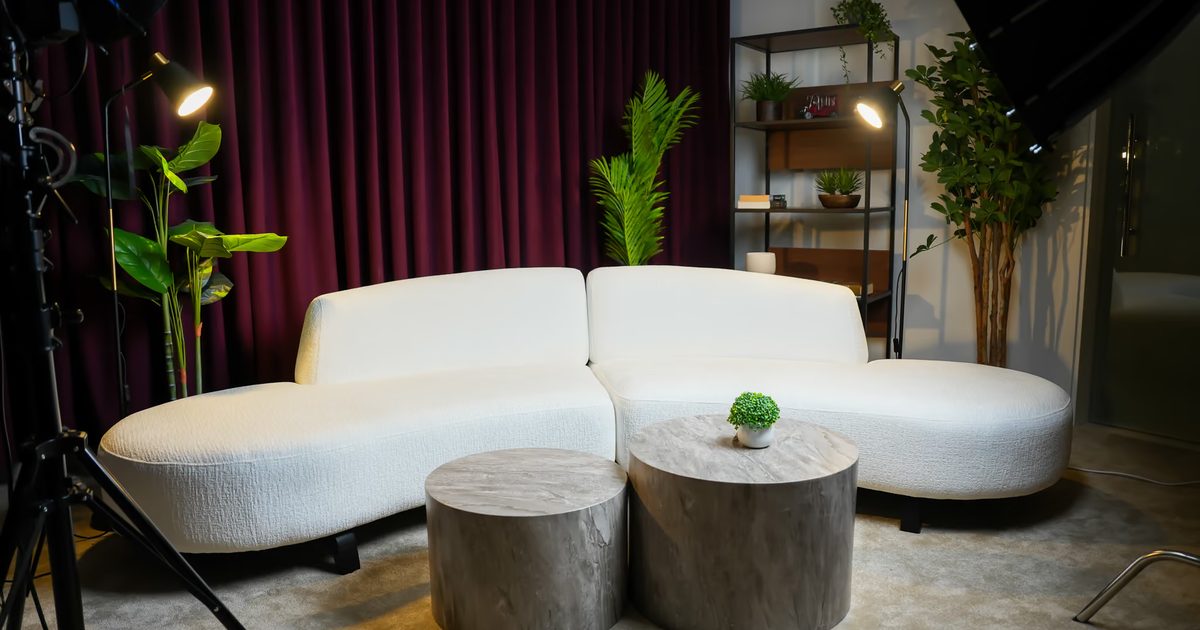
At Ottora Studio, in Abu Hamour, a two-person show usually books the Modern Sofa setup — two seats angled towards each other, lit for two faces, microphones already on the table. Panels of four to six take The Sofa, which lets a group turn inwards so people can actually react to each other rather than all facing the camera in a row.
A typical booking:
| Line | Cost |
|---|---|
| Room, two hours at QAR 260/hr | QAR 520 |
| One additional camera, two hours at QAR 300/hr | QAR 600 |
| Total | QAR 1,120 |
Two cameras — one wide, one close — is what lets an editor cut a rambling forty minutes into something watchable without a visible jump. There are two cameras in the building, so two is the number that can be guaranteed for one session; more are arranged and quoted separately.
Add a camera operator at QAR 300 an hour if you are the one on camera. You cannot watch your own focus while you are talking. Nobody can.
The single best decision: batch
Do not record weekly. Record monthly, and record four episodes.
Three hours takes 15% off the rate and six takes 25%, so batching is cheaper per episode as well as far more likely to actually happen.
When a monthly package makes more sense
If you record every month on a schedule, paying by the hour stops being the right shape. A monthly podcast package is built from your actual show — how many sessions, how long each runs, whether an operator is there, how many cameras, and how many episodes get edited — rather than picked from three tiers.
Episode editing is QAR 500 per episode and can be added to any session. It is worth being honest about whether you will do it yourself: editing is where most podcasts die, four hours at a time on a Thursday night. If there are three unedited episodes in a folder on your laptop right now, that is your bottleneck, and it is not your microphone.
Frequently asked
How much does it cost to record a podcast in Doha?
A podcast session at Ottora Studio is QAR 260 an hour. A two-hour recording with one extra camera is about QAR 1,120. Editing is QAR 500 per episode. Three hours or more takes 15% off, six or more takes 25%.
Can I record a podcast at home in Qatar?
Yes, and plenty of good shows start that way. Use the smallest carpeted room you have, put something soft behind you and behind the microphone, and turn the AC off during takes.
Do I need to bring anything to the studio?
A laptop if you want the files immediately, and an SSD if you want to walk out with them. Microphones and lighting are already there.
How do I get my recording?
Copy it to your own SSD on site, or have it uploaded to Google Drive or WeTransfer.
Can I record in the evening?
Yes. The studio is open Saturday to Thursday, 10:00 to 23:00, and closed on Fridays. Evening slots after 19:00 book out one to two weeks ahead.
Do you record Arabic-language shows?
Yes. The room does not care what language you speak, and neither does the equipment.
How many people can I fit?
Modern Sofa seats four, The Sofa seats six, and the cyclorama takes ten. For anything larger the Full Studio seats twenty.
Can I bring a guest who is only free at short notice?
Availability is live on the booking calendar, so a same-week slot is often there. Evenings are the exception.
Related reading:Podcast studios in Qatar: how to choose one · Starting a podcast in Qatar: the first five decisions · How many cameras does your shoot actually need?
Live availability is on the booking calendar. All the setups are on the studio rental page.