
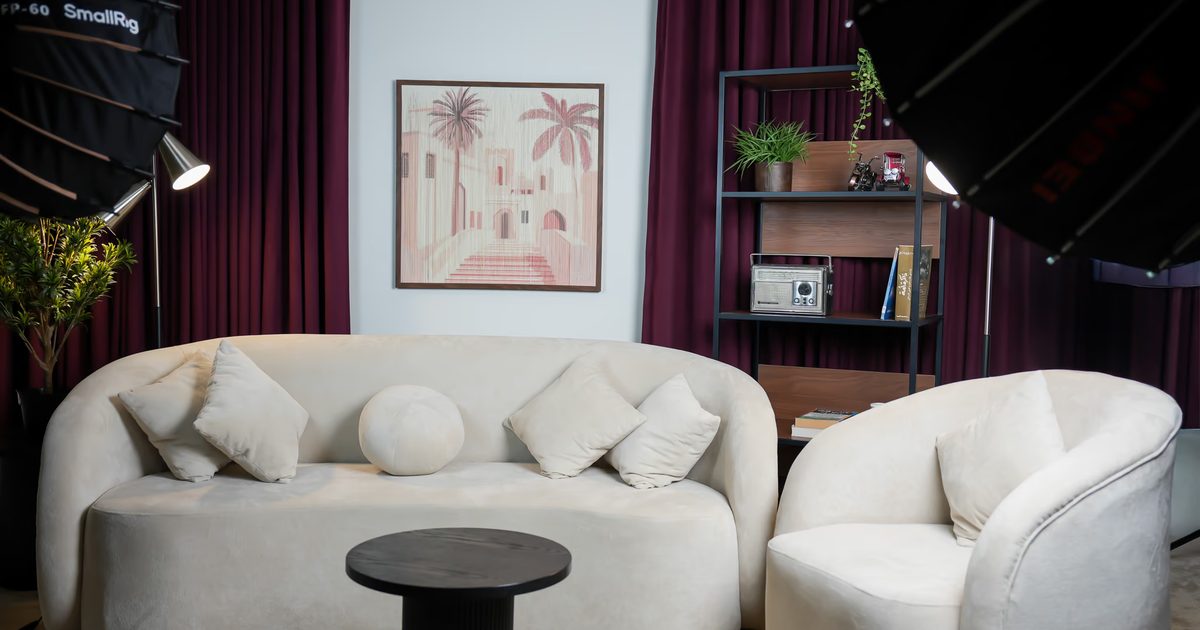
There are more podcast studios in Qatar than there were two years ago, and they are not the same product. Some are treated rooms built for recording. Some are meeting rooms with a microphone on the table and a good camera angle in the photos.
The difference does not show up on a website. It shows up in episode four, when you are editing at eleven at night and cannot get the room hum out of the recording.
- A podcast studio is a room treated for sound, with one microphone per person, lighting already rigged, and at least two camera positions.
- Expect QAR 200–400 an hour in Doha. At Ottora Studio a podcast session is QAR 260 an hour.
- Ask about the minimum booking, how many cameras are actually owned on site, and how you get your files. Those three answers separate studios faster than anything else.
- Two cameras is the setup that makes editing easy. One is fine if the episode goes out unedited.
- Book monthly and batch four episodes. It is cheaper per episode and it is the single best predictor of whether the show still exists in a year.
What actually makes a room a podcast studio
Five things. If a room has all five it is a studio. If it has two of them it is a room you can record in, which is a different and cheaper product, and worth knowing you are buying.
1. Acoustic treatment — which is not soundproofing
These get confused constantly, and they solve different problems.
Soundproofing stops noise getting in from outside. It is expensive, structural, and mostly unnecessary for a podcast — traffic noise is usually not what ruins a recording.
Acoustic treatment stops sound bouncing around inside the room. That is what ruins recordings. In an untreated room your voice reaches the microphone directly, then again a few milliseconds later after reflecting off the wall behind you. Your ear filters that out. A microphone does not, and no plugin fully removes it afterwards.
Treatment is soft surfaces in the right places: panels, fabric, a rug, furniture. You can hear the result immediately when you walk in — a treated room sounds slightly dead, and voices in it sound close rather than distant.
2. One microphone per person
Not one microphone on a table between two people. A shared microphone sits further from both mouths, so it picks up more room and less voice, which is exactly the wrong ratio.
Ask how many microphones the room has and how many people it seats. If the second number is bigger than the first, that is your answer.
3. Lighting that is already there
A studio's lighting should be rigged and set before you arrive. If you are paying an hourly rate and spending the first hour watching someone position lamps, you paid studio rate for setup.
This is a fair thing to ask directly: is the lighting already set for that setup, or does it get rigged when I arrive?
4. At least two camera positions
You do not have to book two cameras. But the room should be able to take two, because the moment you want to edit, the second angle is what makes it possible. More on that in how many cameras your shoot actually needs.
5. A file handover you understand before you book
This is the one people forget, and it is the one that causes the argument.
How do you leave with your recording? Do you bring your own drive? Is it uploaded, and how long does that take? Is there a charge? Who keeps a backup, and for how long?
None of these are difficult questions. They are just much easier to ask before the session than after.
The seven questions to ask before booking any studio in Qatar
Copy these. They take four minutes on WhatsApp and they will tell you more than any showreel.
| Ask this | Why it matters | Ottora's answer |
|---|---|---|
| What is the minimum booking? | A low hourly rate with a four-hour floor is expensive for a two-hour recording. | One hour. |
| How many cameras do you own on site? | "We can arrange any number" means they own none and are subcontracting. | Two, owned in house. |
| Is an operator included or extra? | Changes the real hourly cost by a third. | Extra — QAR 300/hr, optional. |
| How do I get my files? | The most common source of post-session friction. | Copy to your own SSD on site, or upload. |
| Is editing available, and priced how? | Editing is where shows die. Know the number early. | QAR 500 per episode. |
| What happens if I overrun? | You will overrun on session one. | Charged by the hour, no penalty rate. |
| Can I see the room before booking? | Photographs are shot with a wide lens on a good day. | Yes. |
Which setup suits which show
Podcast is not one format. A solo monologue, a two-hander and a six-person panel want different rooms, and booking the wrong one is the most common avoidable mistake.
What a podcast studio costs in Qatar
Most studios in Doha answer this with "contact us". Here are the numbers.
A podcast session at Ottora Studio is QAR 260 an hour. That covers the room, the lighting and the microphones. Studio rental for other formats runs QAR 200 to QAR 400 an hour depending on which setup you book.
Two optional add-ons, both hourly:
- An additional camera — QAR 300 an hour. Two cameras are owned in house, so two is the number that can be guaranteed for a single session.
- A camera operator — QAR 300 an hour. Worth it when you are the one on camera, because you cannot watch your own focus while talking.
Editing is QAR 500 per episode and can be added to any session.
How the volume discount changes the arithmetic
Three hours or more takes 15% off. Six hours or more takes 25% off. Crucially the discount comes off the combined hourly rate — room plus cameras plus operator — not the room alone.
That gap is the entire argument for batching, and it is before you count the time you save by setting up once instead of four times.
Studio, office, home or co-working
All four are used for podcasts in Doha. Each fails differently, and the honest comparison is worth having before you spend anything.
| Home | Office | Co-working | Studio | |
|---|---|---|---|---|
| Cost per session | Free | Free | Membership + room | QAR 260/hr |
| Sound | Poor, improvable | Worst — glass and hard ceilings | Poor | Treated |
| Looks like | A living room | A training video | An office | A show |
| Setup time each session | 30–45 min | 30–45 min | 30–45 min | Near zero |
| Interruptions | Family, neighbours, lift | Colleagues, AC hum | People at the glass | None — the room is yours |
| Still recording in a year? | Rarely | Rarely | Rarely | Usually |
That last row is the one that matters and the one nobody puts in a comparison table. A booked slot in a calendar is the strongest single predictor of whether a show survives past episode six. "When we get a chance" is how podcasts die, and it is a scheduling problem rather than an equipment problem.
There is a longer version of this comparison in where to record a podcast in Doha.
Where Ottora Studio fits
Ottora Studio is in Abu Hamour, Doha, open Saturday to Thursday, 10:00 to 23:00, closed Fridays. Six setups, all lit and ready before you arrive, all bookable by the hour with a one-hour minimum and no membership.
For podcasts specifically:
- Two-person shows usually take the Modern Sofa setup — two seats angled towards each other, lit for two faces, microphones already on the table.
- Panels of four to six take The Sofa, which lets a group turn inwards and react to each other rather than sitting in a row facing the lens.
- Anything video-led that needs a clean, seamless background takes the cyclorama.
Evening slots after 19:00 are the busiest and generally book out one to two weeks ahead. There is parking, and an e-gate at the entrance that opens when you call.
Getting the most out of a studio session
The studio is the easy part. These are the things that separate a good session from an expensive one.
Batch, and bring shirts. Record four episodes in one booking. Change shirts between them so the episodes do not look like one long day, which they are.
Put the nervous one in the middle. Not first, when you are cold, and not last, when you are tired.
Water, not coffee. Coffee dries you out in a way that is audible by episode three.
Write the first line of each episode down. Not a script — one sentence. Openings are where people flounder, and flounder costs edit time.
Agree who talks first after a question. Two hosts talking over each other at every handover is the single most common thing an editor has to fix.
Leave the last twenty minutes free. You will want to re-record something. Everyone does.
Frequently asked
How much does a podcast studio cost in Qatar?
At Ottora Studio a podcast session is QAR 260 an hour, with 15% off from three hours and 25% off from six. Other studio setups run QAR 200 to QAR 400 an hour. Cameras are QAR 300 an hour each and an operator is QAR 300 an hour, both optional.
Are there podcast studios in Doha open in the evening?
Yes. Ottora Studio is open until 23:00, Saturday to Thursday, closed Fridays. Evening slots after 19:00 are the most requested and book out one to two weeks ahead.
Do I need to bring my own equipment?
No. Microphones and lighting are already in the room. Bring a laptop if you want to check the files, and an SSD if you want to walk out with them.
Can I record an Arabic-language podcast?
Yes. The room and the equipment do not care what language you speak. Arabic and English shows record here in equal numbers.
How many cameras should I book?
Two for almost every two-person show, because the second angle is what makes cuts invisible. One is correct if the episode goes out roughly as recorded.
What is the minimum booking?
One hour. No membership, no day-rate commitment, no package you have to buy into first.
Do you edit episodes?
Yes — QAR 500 per episode, addable to any session. It is worth being honest with yourself about whether you will do it yourself. If there are three unedited episodes on your laptop right now, that is the bottleneck, not your microphone.
How far ahead should I book?
A week for a daytime slot, two for an evening one. Live availability is on the booking calendar.
Related reading:Where to record a podcast in Doha · Starting a podcast in Qatar: the first five decisions · How many cameras does your shoot actually need?
Live availability for every setup is on the booking calendar, and the rooms themselves are on the studio rental page.