
Most podcasts do not fail on equipment. They fail on decisions that were never actually made, and the failure shows up around episode six as a scheduling problem.
Here are the five that matter, in the order they should be answered.
- Format: two hosts is the most sustainable. Solo is hardest to keep up; interview is hardest to schedule.
- Language: one per show, consistently. Code-switching inside an episode is fine; alternating episodes is not.
- Length: 25–40 minutes. Completion rate is what platforms use to decide whether to recommend you.
- Schedule: fortnightly beats weekly. Record four episodes ahead before publishing episode one.
- Where: a booked slot is the strongest single predictor that the show still exists in a year.
1. Solo, two-host, or interview?
Each one is a different amount of work, and the difference is not obvious until you are doing it.
Solo is the hardest to sustain and the cheapest to produce. No scheduling, no guests, no cancellations — but you carry the whole episode, and there is nobody to rescue a flat moment. Most people overestimate how long they can do this. If you have never spoken alone to a camera for thirty minutes, try it once before you commit to a format built on it.
Two hosts is the most sustainable. Conversation happens naturally, the energy holds, and if one of you is having a bad week the other carries it. The risk is that you agree with each other about everything, which is quietly boring — the fix is to decide in advance who is arguing which side.
Interview is the easiest to make interesting and the hardest to schedule. Every episode needs a guest, and guests cancel. The rule that saves interview shows: record two guests in one session, so one cancellation does not cost you a month.
| Format | Sustainability | Scheduling load | Best for |
|---|---|---|---|
| Solo | Hardest | None | A strong single voice with a lot to say |
| Two hosts | Easiest | Low — one other diary | Most people starting out |
| Interview | Medium | Highest | Building a network as much as an audience |
2. Arabic, English, or both?
In Qatar this is a real decision, not a formality.
One language, consistently is almost always the right answer. Mixed-language shows fragment their own audience — listeners who want Arabic get half an episode, listeners who want English get the other half, and neither group recommends it to anyone, because they cannot predict what the next episode will be.
Code-switching within a conversation is different, and it is fine. That is how people in Doha actually speak, and a show that reflects it sounds natural rather than confused. The distinction is between this episode is in Arabic and sometimes drifts into English, which works, and we alternate episodes, which does not.
If you genuinely need both audiences, make two shows with two feeds. It is more work and it is the only version that behaves properly in podcast apps, where a single feed means one listener sees every episode regardless of language.
3. How long?
Shorter than you think.
The most common beginner mistake is a ninety-minute first episode, because it feels like value. It is not. Almost nobody finishes it, and completion rate is what platforms use to decide whether to recommend you — a forty-minute episode watched to the end outperforms a ninety-minute one abandoned at twenty.
Twenty-five to forty minutes is the sustainable range for a conversational show. Long enough to say something, short enough to fit a commute, and short enough that editing it does not consume your weekend.
Decide the length before you record, not after. A show recorded to a target is tighter than a show that ran as long as it ran.
4. What schedule can you actually keep?
Not what you want. What you can keep in February when work is busy and you are tired.
Fortnightly beats weekly, for almost everyone starting out. A fortnightly show that publishes for a year is a real show. A weekly show that publishes six times and stops is nothing.
Publish on a fixed day. People form habits around days, and the algorithm reads consistency.
Record ahead. This is the part that makes everything else work.
Batching also costs less: three hours or more takes 15% off the studio rate and six hours takes 25%.
5. Where do you record?
You have four options in Doha — home, your office, a co-working room, or a studio — and each fails differently. The long version is in where to record a podcast in Doha; the short version follows.
Home is free and sounds like home; hard surfaces send your voice back at you a few milliseconds late, and no plugin fully removes that. An office is worse acoustically, because a modern Doha office is glass on two sides and a hard ceiling — and it gets louder in the evening, not quieter, as the air conditioning works harder and the traffic outside drops away.
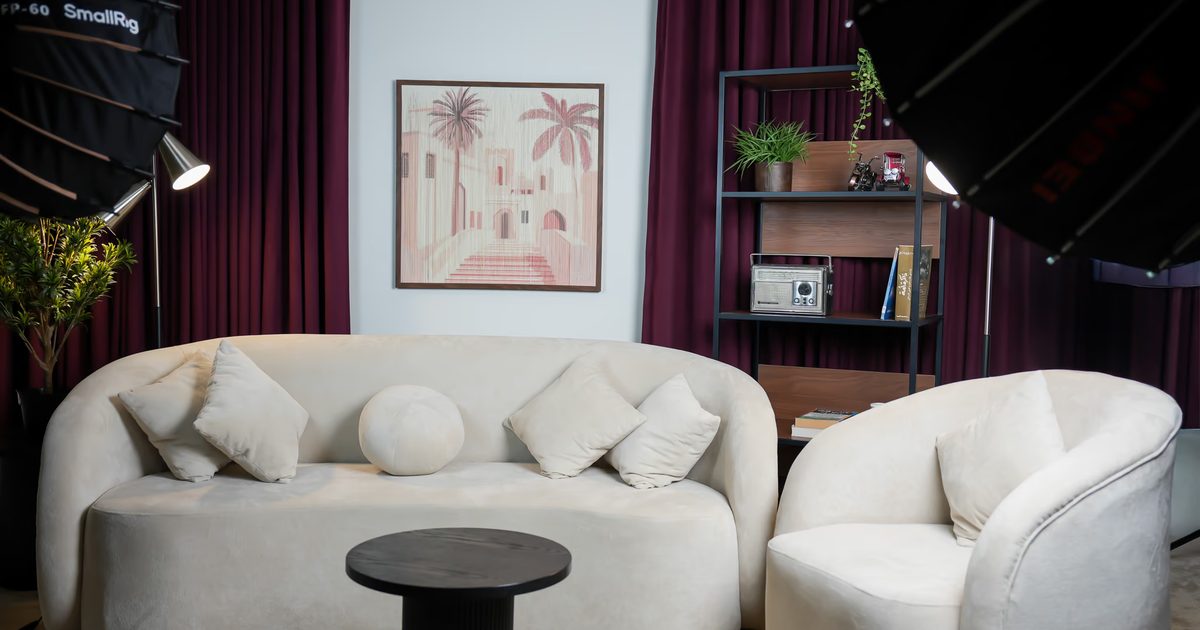
A studio is a treated room where none of that happens. At Ottora Studio in Abu Hamour a podcast session is QAR 260 an hour, and two-person shows generally book the Modern Sofa setup. Panels take The Sofa, which seats six and lets people angle inwards so they can react to each other.
The real argument for a studio is not audio quality. It is that a booked slot in a calendar is the strongest single predictor of whether a show is still running in a year. "When we get a chance" is how shows die.
The equipment question, answered briefly
You asked it first and it matters least, so it is last.
Two microphones, one per person, each about a fist from the mouth and angled slightly off-axis so breath does not hit it straight on. Never one microphone shared between two people — a shared mic picks up the room between you, and the room is exactly what you are trying to avoid recording.
One camera if the episode goes out roughly as recorded. Two if you intend to edit, because a second angle is what lets you cut ninety seconds of waffle without a visible jump. Two cameras are available here at QAR 300 an hour each; two is also the number owned in house, so it is the number that can be guaranteed for one session.
Headphones for everyone, so you hear problems during the recording rather than after it. This is the cheapest item on the list and the one most often skipped.
Everything else is optional for the first year.
What it costs to start
Three honest versions, all real.
| Route | Per episode | What you get |
|---|---|---|
| Fully self-produced at home | Near zero | Your own kit, your own room, your own edit |
| Studio, batched, self-edited | About QAR 166 | Treated room, lighting, mics — 4 eps in one 3-hour session |
| Studio + camera + operator + editing | About QAR 2,220 | A produced episode you do nothing to afterwards |
Most shows that last start in the middle row and move up once they know the show works. Starting in the bottom row before you know whether you enjoy making it is the most common way to spend a lot and publish four episodes.
A realistic first-year plan
| Month | What happens |
|---|---|
| Month 1 | Decide the five above. Record four episodes in one three-hour session. |
| Month 2 | Publish the first two. Record four more. |
| Month 3 | Publish two. Look at completion rates, not downloads. |
| Months 4–6 | One recording session per month, four episodes each. |
| Month 7 | Decide whether to continue. You now have real data instead of a feeling. |
Seven months in, you will have published roughly fourteen episodes and spent about six studio sessions. That is a genuine test of whether you want to make a podcast, and it costs less than most people spend on equipment before recording anything at all.
Frequently asked
How much does it cost to start a podcast in Qatar?
A three-hour session producing four episodes is QAR 663 for the room after the volume discount — about QAR 166 an episode. Add a camera at QAR 300 an hour or editing at QAR 500 an episode if you want them.
Do I need to speak Arabic to podcast in Qatar?
No. English-language shows have a large audience here. Pick one language and stay with it.
How many episodes should I record before publishing?
Four. It gives you a buffer, and it means episode one is not also your first ever recording.
How long should episodes be?
Twenty-five to forty minutes for a conversational show. Completion rate matters more than length.
Can I record in the evening?
Yes. Saturday to Thursday, 10:00 to 23:00. Fridays are closed. Evening slots book out one to two weeks ahead.
What equipment do I actually need?
One microphone per person, headphones for everyone, and one camera if it is a video show. In a studio all three are already there.
What if I want someone else to handle the production?
A monthly podcast package covers sessions, cameras, an operator and editing, configured around your show rather than picked from a tier list. The pricing is worked through in podcast packages in Doha.
How do I know if it is working?
Completion rate first, then repeat listeners, then downloads. Downloads are the number everyone quotes and the least useful of the three in the first six months.
Related reading:Podcast studios in Qatar: how to choose one · Where to record a podcast in Doha · Podcast packages in Doha: hourly or monthly?
Live slots are on the booking calendar, and the setups are described on the studio rental page.